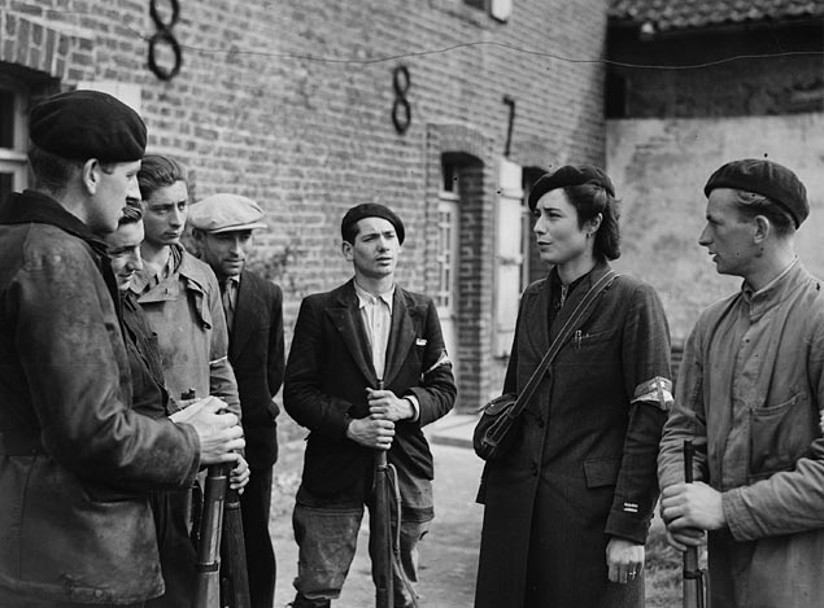
‘This analysis on pseudo operations draws heavily on the foundational research conducted by Lawrence E. Cline, whose extensive studies provide deep insights into the complexities of such operations. While we build on his scholarly work, the interpretations and discussions that follow aim to expand upon and contemporize his findings for current military and strategic contexts.‘
This conise report is worth the read. See full report, ‘Pseudo Operations and Counterinsurgency: Lessons from Other Countries’: https://www.blackwaterusa.com/pseudo-operations-and-counterinsurgency
From the article, RE:
Definition and Historical Origins
The term “pseudo operations” refers to military and paramilitary operations conducted by forces disguised as enemy units or insurgents. These operations are intended to deceive, confuse, and ultimately destabilize enemy forces from within. Historically, the use of such tactics can be traced back to ancient warfare, but their formal codification and widespread implementation occurred during World War II.
During the Second World War, various Allied units engaged in operations that involved deception tactics akin to modern pseudo operations. For instance, the British employed units like the Special Operations Executive (SOE) to conduct espionage, sabotage, and reconnaissance in occupied Europe, often disguising their activities as those of local resistance groups.
And this:
Moral Dilemmas:
The core strategy of pseudo operations—impersonating enemy forces—raises significant ethical questions. The deception involved can blur the lines between combatant and non-combatant, potentially leading to violations of the laws of war and international humanitarian law. For instance, the Geneva Conventions dictate clear rules on the treatment of civilians and combatants, and violating these norms can undermine the ethical standing of military forces.
— I’m a little surprised that ‘perfidy’ is never specifically mentioned, but ‘deception’ is used instead. There are very clear rules of war against perfidy, particularly as outlined in the Hague Conventions.
Perfidy is illegal in war; for example, it is a violation of the rules of war to wear the uniform of an enemy. In cases where irregular forces/beligerents don’t have a common uniform or no uniforms, ideally they should be wearing something, an insignia of some kind identifying them for who they are as combatants, like an armband, or, for example, Hamas combatants wearing a balaclava and green shahada headband or just the headband– though Hamas often don’t do this and wear civvies. (Mind you, someone in civilian clothes carrying a weapon is the identifier and makes that individual fair game as per the rules.)
The methodology and history of guerrilla warfare and insurgencies’ conduct and tactics can often intentionally or unintentionally equate to acts of perfidy and acts of terrorism by modern terms and definitions.
Image below, from a presentation I did a few years ago, ‘A History of Guerrilla Warfare and Insurgency Conducts Equating to Terrorism‘, Guerrilla warfare and insurgencies have often applied methods and tactics that can be construed as terrorism by modern definitions:
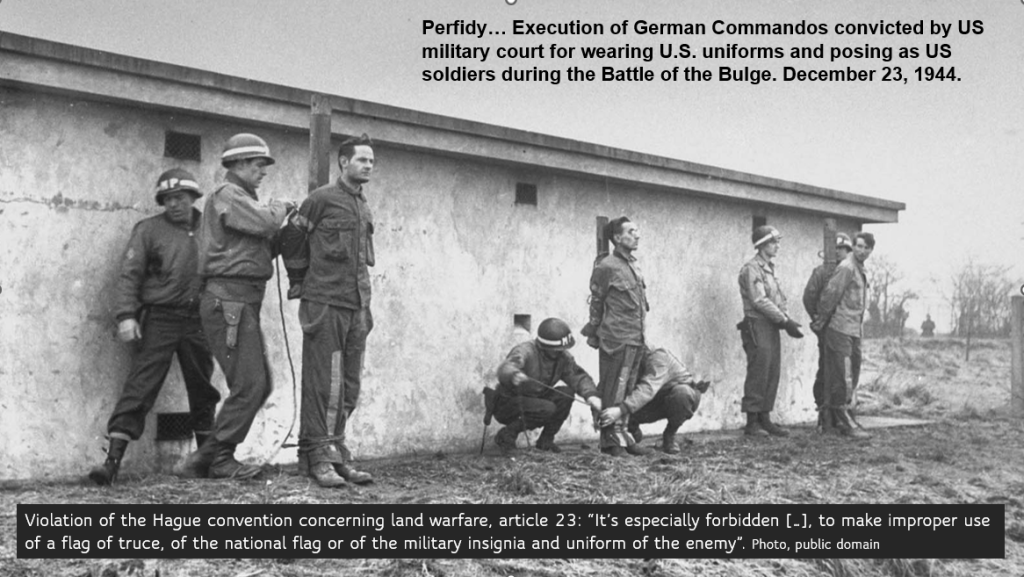
There are reasons that spies were readily executed by all sides during WWII, because spying is perfidious.
And, like it or not, Germans executing partisans was often within the rules of war. Partisans were perfidiously carrying out acts, such as espionage, assassinations, sabotage, etc.
Meanwhile, as the Blackwater article lays out as an example, British Special Operations Executive (SOE) who carried out ‘espionage, sabotage, and reconnaissance in occupied Europe, often disguising their activities as those of local resistance groups‘ was perfidious.
–RdM
Great insight, thanks for posting the piece