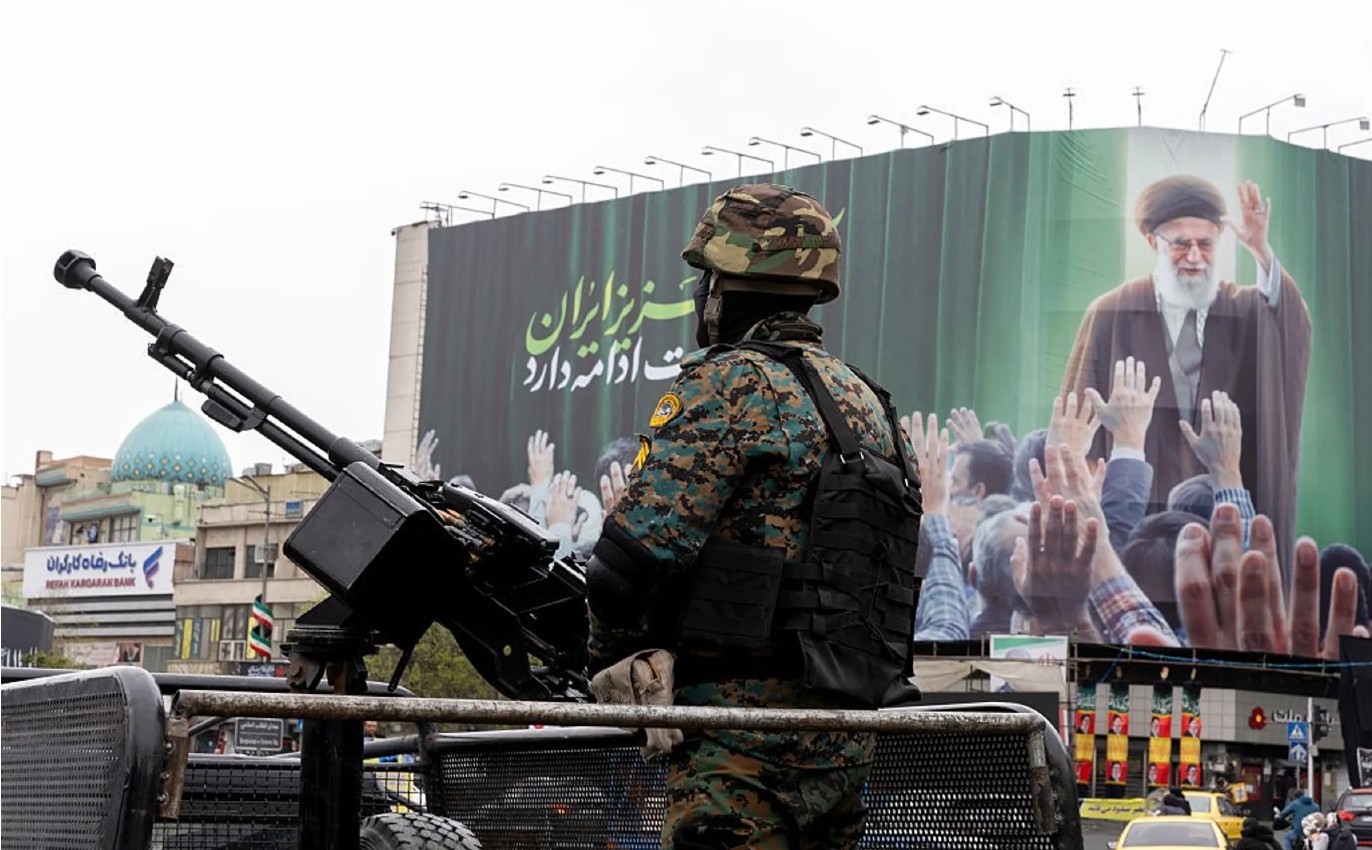
Even after devastating U.S.-Israeli strikes, intelligence assessments suggest Iran’s regime is hardening, not collapsing.
★ For this report, Hollie McKay asked for my input. –RdM
The Cipher Brief link to the report: https://www.thecipherbrief.com/sobering-assessment-of-irans-resilience

Four weeks into Operation Epic Fury, with airstrikes having killed a sitting supreme leader, wiped out
scores of top military and intelligence commanders, and significantly degraded Iran’s missile arsenal
and naval capacity, Washington is confronting a conclusion that was reached by its own intelligence
community before the first bomb fell: the Islamic Republic is not going anywhere.
A National Intelligence Council assessment completed in February concluded that neither limited
airstrikes nor a larger, prolonged military campaign would be likely to result in a new government taking over in Iran, even if the current leadership were killed. The briefings delivered to President Trump were described by one source familiar with the findings as “sobering.”
A multitude of intelligence reports now provide consistent analysis that the regime is not in danger of
collapsing and retains control of the Iranian public. The war’s costs are nonetheless mounting.
More than $16 billion has been spent so far, 13 U.S. troops have been killed, and Iran’s grip on the
Strait of Hormuz has slowed shipping traffic to a trickle, creating a historic oil disruption that has
sent global energy markets into turmoil. Daily oil exports from the Middle East have fallen by at least
60 percent since the war began, the IEA has said, calling it the largest supply disruption in the global
oil market’s history.
A U.S. intelligence official, speaking to The Cipher Brief on background, captured the core dilemma
plainly, “You can’t get regime change from the air, and who is to replace them when there is no viable
alternative.”
The son rises — harder than the father
Nine days into the war, Iran’s Assembly of Experts met and named a new supreme leader. They chose
Mojtaba Khamenei 56, second son of the slain Ayatollah Ali Khamenei, and in doing so gave
Washington an answer it had not been looking for. Inside Iran, critics felt the sting of a republic born
from the ashes of dynastic rule that had just handed the top job from father to son. President Trump
called the selection “a big mistake” and said Mojtaba was flatly “unacceptable” to him.
The new supreme leader is widely assessed as even more hardline than his father, though the full
contours of his leadership remain difficult to read, in part because he has not appeared in public since
the war began, knowing that he is being actively targeted.
For decades, he operated in the shadows of his father’s office. U.S. diplomatic cables published by
WikiLeaks in the late 2000s referred to him as “the power behind the robes” and his father’s
“principal gatekeeper.”
At the same time, a 2008 cable reportedly assessed him as “a capable and forceful leader and
manager” though it also noted his lack of theological qualifications and relative youth. His path to
power ran not through religious scholarship; he holds no senior clerical rank and has published no
works of Islamic jurisprudence, but through the IRGC, with which he forged ties during the Iran-Iraq
war in the late 1980s and cultivated ever since.
Intelligence experts stress that Mojtaba essentially owes the IRGC for his ascendance, and in that
vein, he isn’t going to have the same broad leverage as his father. The succession process itself
underscored that dynamic. The IRGC argued that the war required a swift process and that selecting
a candidate who defied the United States, contacted Assembly of Experts members, and prompted
objections, yet, in the end, they felt compelled to support him. IRGC leaders, Basij commanders, and
top security officials had unparalleled access to the assembly, many of whose members rely on the
Revolutionary Guards for personal protection.
The first statement attributed to Mojtaba since his appointment came on March 12, read aloud by a
state television anchor over a still photograph — the new supreme leader himself nowhere to be
seen. The tone left little room for interpretation.
“The lever of blocking the Strait of Hormuz must definitely continue to be used,” he declared, not as
a negotiating position, but as a statement of intent. The waterway that moves a fifth of the world’s oil
had become, in his telling, a weapon.
Some private sector analysts noted that while his rhetoric toward the United States and Israel was
uncompromising, he did not fully close the door to political outcomes, placing responsibility for
ending the war squarely on Washington. Iran’s parliament speaker, Mohammad Bagher Ghalibaf, was
less equivocal.
On March 17, he posted on X that the Strait of Hormuz “won’t return to its pre-war status.” Two days
later, Expediency Council member Mohammad Mohaber went further still, calling for a “new regime”
for the strait that would allow Iran to sanction the West by denying passage to its ships. Taken
together, the message to Washington was hard to misread: across the Islamic Republic’s power
structure, this war has produced no moderates.
IRGCistan: the state that emerges
What American airpower has effectively accelerated is not the dismantling of the Islamic Republic but
the consolidation of its most dangerous institutional element. The IRGC is taking an even greater role
in the domestic affairs of the state, ensuring the structure of the regime stays in place, while Iran’s
opposition remains fractured without a credible leader capable of challenging hardline officials.
A telling example of who holds actual power came one week into the war, when President Masoud
Pezeshkian apologized for Iran’s attacks on Gulf states, saying he “personally apologizes to
neighboring countries that were affected by Iran’s actions.” The IRGC and hardliners pushed back
immediately, a hardline parliamentarian called the statement “weak, unprofessional, and
unacceptable,” forcing Pezeshkian into a climbdown that notably omitted his original apology from
the official readout. This has been widely interpreted as the IRGC now being in full charge of the
embattled nation, and calling the shots as to who, how and when to attack.
Despite sitting on the interim leadership council formed to administer the country while a new
supreme leader was selected, Pezeshkian appears to have been reduced to a figurehead. The elected
civilian layer of the Iranian state has been hollowed out in real time.
That hollowing-out has only deepened since. On March 17, Ali Larijani — the secretary of Iran’s
Supreme National Security Council and one of the most prominent non-clerical figures in Iranian
politics — was killed in an Israeli airstrike, removing the highest-level official to be assassinated since
Khamenei himself. U.S. and Israeli intelligence had assessed Larijani as Iran’s de facto leader in the
weeks after the war’s opening strikes, given widespread doubts about Mojtaba’s capacity to govern.
Iran has since named Mohammad Bagher Zolghadr, a hardline former IRGC deputy commander, to replace him; a move that further consolidates the Guards’ grip over the regime’s security architecture.
The pattern is difficult to ignore. Each leadership vacancy created by the war’s decapitation strikes
has been filled not by civilian or clerical figures but by men with deep IRGC roots. As one U.S.
intelligence official speaking on background to The Cipher Brief told us, the internal dynamics are
shaped less by strategy than by the weight of an accepted narrative — and that narrative, for now,
belongs to the guards.
Royce de Melo, a security and defense consultant and analyst specializing in the Middle East and
Africa, tells The Cipher Brief that he sees the current trajectory as a natural, if not inevitable,
evolution.
“As fanatical loyalists, the IRGC have always been the power behind the regime since the 1979 Iranian
Revolution; they are Iran’s Praetorian Guard,” he explains. “For the IRGC to take control of the
government temporarily, be it until this war ends, or with a longer-term intent, in my opinion, would
be a natural course.”
A senior Arab official told Axios that the IRGC is taking over Iran and that its members are “highly
ideological and are ready to die.” Whether this constitutes a full “IRGCistan” remains debated. De
Melo, however, cautions against treating the framing as settled.
“It’s early days, and no one seems certain as to what is happening with the government at the
moment,” he continues. “Nonetheless, even if Iran’s government becomes military-dominated under
the IRGC, that is not to say it still won’t remain theocratic. It can be both military-dominated and
theocratic.”
The senior director of the Iran program at the Foundation for Defense of Democracies, Behnam Ben
Taleblu, has closely tracked this dynamic. The regime, he argues, is not deluded about its own
condition — it knows the damage is real. What it is counting on is that a wounded adversary can still
make the price of finishing the job too high. The IRGC’s track record of reconstituting after setbacks
is a significant part of why that bet is not entirely unreasonable.
The IRGC has buried commanders before and found new ones. Its missile production was designed
from the ground up to keep running under pressure, drawing on domestic supply rather than imports that could be choked off. Strikes can hollow out a building. They are less effective against an institution that knows how to reconstitute — and Western policymakers are finding that out as the war continues.
There is also no one waiting to take over. The Iranian opposition is split along ethnic, ideological, and
geographic lines, with no figure capable of commanding broad national support and no organization
with the reach to matter. Azizi, a postdoctoral associate and lecturer at Yale, puts the IRGC’s position
plainly: not a single chain of command, but circles and networks that have spent decades threading
themselves through Iran’s economy and military alike. You do not dislodge that with bombs.
A harder adversary than the one Washington set out to degrade
The administration’s stated objectives — the missiles, the navy, the nuclear program — may yet be
achieved. Inside the intelligence community, however, the more unsettling question has never really
been about the targets. It has been about what comes after. The consistent answer across multiple
outside assessments is not reassuring: the Iran that emerges from this war is shaping up to be harder
to manage than the one Washington decided to strike.
Jonathan Panikoff, who served as former deputy national intelligence officer for the Near East at the
National Intelligence Council before becoming director of the Atlantic Council’s Scowcroft Middle
East Security Initiative, described the best-case scenario for a post-war Iran as one in which there is
meaningful competition for power — but added that he was skeptical such an outcome would arise.
“Somebody with guns fundamentally has to switch sides or stand aside,” he said. That has not
happened.
The nuclear dimension adds a further layer of complexity. IAEA Director General Rafael Grossi has
been unambiguous on the point: military action has badly damaged Iran’s nuclear program, but it
cannot erase the knowledge, materials, and industrial capacity that would allow Tehran to rebuild.
“You can’t unlearn what you’ve learned,” Grossi said, adding that Iran retains the capabilities and the
industrial base to reconstitute.
De Melo also flags what he sees as the variable most likely to shape Iran’s rebuilding speed: Beijing
and Moscow. Chinese companies have kept the pipeline of dual-use technology moving — missile
fuel components, electronics, drone engines — throughout the conflict.
Russia, meanwhile, has spent years on the receiving end of Iranian military hardware, taking in billions
of dollars’ worth of equipment and drone technology since 2021. The reversal De Melo describes is
straightforward: Russia can now send Iranian-design drones, manufactured on Russian soil, back the other way.
A Pentagon source, speaking to The Cipher Brief on background, offered a sobering structural
observation about how intelligence informs — or fails to inform — decision-making at the top.
“In my experience, what happens is you submit a brief that is then accepted, edited or rejected on
the basis of the accepted narrative,” the source cautions. “It is narrative, whatever that might be,
which is controlling.”
It is a dynamic that troubles those who have spent careers watching Washington repeat the cycle.
Del Wilber, a retired CIA case officer, warns that the administration risks mistaking tactical gains for
strategic resolution. Declaring victory short of complete regime change, he argues, would be a
fundamental error.
“Iran will only redouble its efforts to reconstitute their weapons development programs quietly, and
stir up mischief in the region,” he tells The Cipher Brief. “Nothing will stop the existing regime from
pursuing its goal of the destruction of Israel and hurting the United States.
The Cipher Brief is committed to publishing a range of perspectives on national security issues
submitted by deeply experienced national security professionals. Opinions expressed are those of the
author and do not represent the views or opinions of The Cipher Brief.
Have a perspective to share based on your experience in the national security field? Send it to
[email protected] for publication consideration.
Read more expert-driven national security insights, perspective and analysis in The Cipher Brief
❇️ ADDENDUM (09 April 2026): RE:
‘Chinese companies have kept the pipeline of dual-use technology moving — missile fuel components, electronics, drone engines — throughout the conflict.‘
To clarify this sentence, China is supplying dual-use technology to Iran, stuff that slips under the sanctions because these are not sanctioned material, but can be used in the production of drones, missiles, weapons, military equipment, etc. (Meanwhile, China is also illegally supplying sanctioned stuff too.) I think there was a misunderstanding about what I’d originally said. Missile fuel components and drone engines would likely be sanctioned and are not dual-use technology or parts. Electronics and items like nuts and bolts can be dual-use and used to build drones and missiles. See? — RdM
100% Royce. The IRGC will now take full ownership over the ” Islamic Republic of Iran “. Any ” Peace ” in the Middle East is contingent on the absolute destruction of these RADICALS.
The White House’s desire is to have a regime change carried out by the Iranian people themselves. It’s a hard task.
If there is an uprising, there is a chance the army will turn on the IRGC or claim neutrality, as it did in 1979.
However, the IRGC factor likely won’t appreciate the army declaring neutrality, and thereby the IRGC will take them on directly (as they would be seen as traitors) and force the Army into taking sides.
This means there is also the chance of civil war if things really kick off against the regime.
I know that there have been attacks on the military and the IRGC by armed Iranian opposition. (I’ve seen a video of some firing AKs on an IRGC checkpoint at night from a moving car.) Without internet and good communications, the word getting out that there are armed factions attacking Iranian forces is not getting the notice it needs to perhaps help initiate some momentum.
Lots of factors, variables and scenarios to consider.
At the end of the day, the IRGC is powerful and motivated because of their religious fanaticism and thereby will be very difficult to dismantle, but not impossible. It’s the nature of the IRGC beast.