This article was originally posted on LinkedIn on August 11. See: https://www.linkedin.com/pulse/iberian-conquest-apologist-posting-historical-facts-context-de-melo-imhsc/?trackingId=3k%2FdFIXzUlfaJGmFn64fZQ%3D%3D
There is a posting in Spanish that presents a lot of misconceptions and misdirection that has been taught for a long time about the Islamic invasion of Iberia (i.e. what is today Spain and Portugal) and Islamic rule. Instead, it seems to present an apologetic, friendly view of the invasion, along with an extremely narrow and biased perspective about the reality, truths, facts and complexities, which is full of omissions, about the Islamic conquest and Islamic rule.
First, Iberia was invaded by a foreign people militarily, a foreign culture and a foreign religion, whose goal was to obtain riches, slaves, lands, and to conquer Christian lands and Islamise them and make money from them, as they had done throughout the Middle East and North Africa. It was colonization.
➡️ Here is the link to the posting: https://www.linkedin.com/posts/josebaro_en-el-711-un-ej%C3%A9rcito-cruz%C3%B3-el-estrecho-activity-7491380705432887296-Jecq?utm_source=share&utm_medium=member_desktop&rcm=ACoAAALG3h0BmCuAbEV3iAYJNZHCQ1bHqD_qO9k Have a look.
Below are the comments I made (in English) on the posting, hopefully putting things in perspective and context by pointing out the misconceptions and/or the intentionally misleading points in the Spanish commentary by breaking it down:
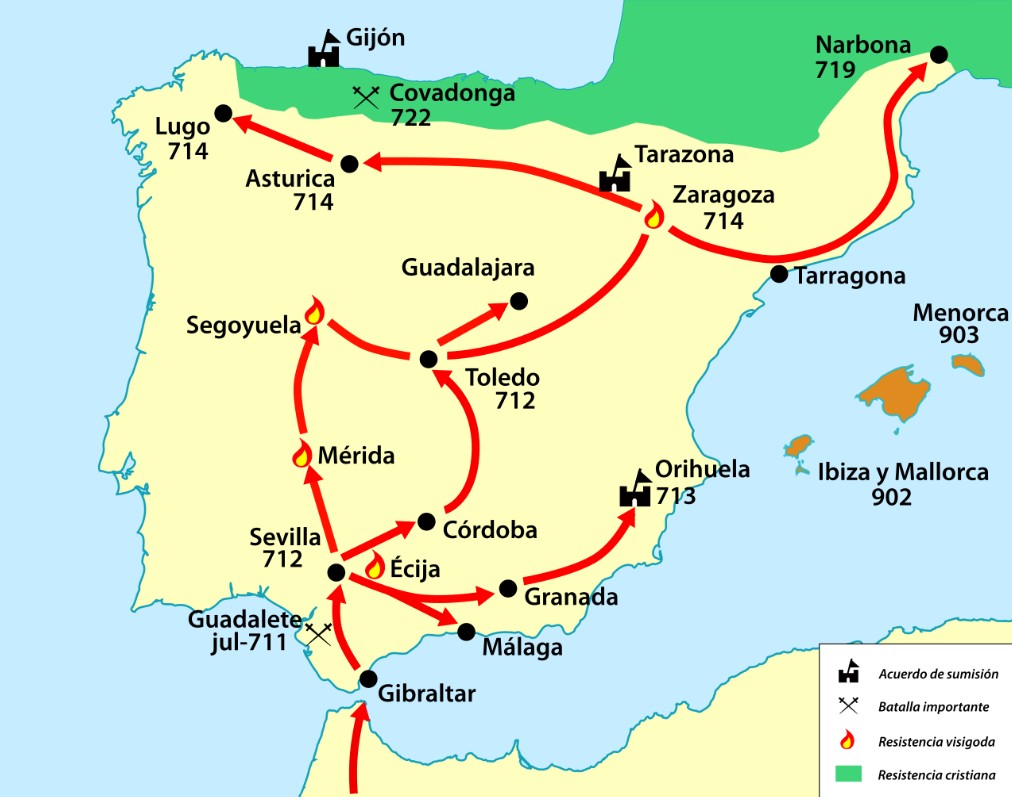
This seems like a whitewash of history. ℹ️ And most of all, the image of this posting, IMHO, appears to glorify Islamic conquests and invasions.(Translated into English):
◉ RE: “Córdoba became the capital. In the 10th century, Abd al-Rahman III proclaimed the Caliphate,…” ➤ By 1031, Córdoba was no longer a capital (of the Umayyad empire and caliphate). You see, Iberia was, in the end, often divided among various Muslim groups and factions. Muslim rulers and factions would ally with Christian kingdoms to confront rival Muslim groups. It was not all kumbaya.
◉ RE: “...and Córdoba boasted 500,000 inhabitants,...” ➤ Most historians believe this number is exaggerated, that the population more likely fell between 100,000 to 200,000.
◉ RE: “…illuminated streets,...” ➤ There is debate over whether it is as big a deal as many have claimed, or whether it was really a centralized public utility or the result of private lamps outside the home.
◉ RE: “…700 mezquitas…” ➤ This is either intentionally misleading, i.e. disinformation, or it’s a mistake. The real number of mosques in the city was more like over 300.
And with that being said, what about the churches? No mention of churches? Hm? I wonder why? No one is sure how many churches existed during the Umayyad rule, but one estimate puts the number at at least four functioning churches and chapels.
This posting also fails to mention the special tax called the Jizya tax put on Dhimmis, i.e. a tax applied to Christians (i.e. the natives of Iberia) and Jews as second-class citizens. This posting does not mention what happened to Christians and Jews when they could not pay the tax. And it mentions nothing of the second and third-class citizenship of the Christians and Jews.
◉ RE: “...and 900 public baths,…” ➤ Again, ‘modern historians suggest the actual number of major public bathhouses was closer to 300’. And where did the idea of public baths come from? It was Roman. (And those baths were not particularly healthy.)
◉ RE: “...while Paris barely reached 20,000 and smelled unpleasant.” ➤ Context is everything. Paris was a small provincial town in the 10th century, not a capital. It didn’t compare for reasons, but to say Paris smelled unpleasant, IMHO, I suspect Cordoba wasn’t much better.
◉ RE: “Here, science flourished. Ibn Bajjah (Avempace) pondered physics, Averroes commented on Aristotle, Maimonides wrote on medicine, the Library of Al-Hakam II held 400,000 books, the translators of Toledo rendered Greek and Arabic into Latin, and thus Europe awoke from its slumber.” ➤ There is a lot to digest in this; this is not as simple as this paragraph makes it seem.
Christendom, most of all, was not under a slumber. This idea that Europe was in a “dark age” is misunderstood in its original sense, i.e., that it was a shame that the Roman and Greek eras had collapsed, that is was a “dark” time because of the loss of those civilizations.
Islamic Iberia was not wholly responsible for Europe’s advancements in thought and sciences. Many areas in Christendom had preserved Roman and Greek works. There was no central library per se, but Christendom did, nonetheless, preserve these as well.
*Justin Martyr (100–165 AD) was an early Christian scholar who referred to Greek philosophers. ‘He argued that figures like Socrates and Plato wrote under the influence of the Logos and possessed partial truths before Christ’s incarnation.’
‘*’St. Augustine (354-430 AD) frequently referred to and engaged with Greek philosophers.’ This is part of Christian history and tradition that was recorded…
*’John Scotus Eriugena (c. 800 – c. 877) was a prominent 9th-century Irish Christian philosopher and theologian at the Carolingian court. He integrated Christian theology with Greek Neoplatonic traditions…’
Where did the Muslims in Iberia get the Greek and Roman materials? I’d say most of it came from the local Christians, the monastaries, and more, the Christians who were the original preservers of those writings.
The idea that the Muslims of Iberia preserved everything while the rest of Europe knew nothing is extremely misguided and maliciously wrong. As I show, Christendom had records of the old philosophers.
Here’s the question? What did the Arabs/Muslims do with this information that they apparently had? Nothing.
In Baghdad, there would be gatherings of thinkers discussing the Greek philosophers and other related matters, only to say how interesting it all was, while they would always conclude that Islam is best and overrides everything. So what did they gain? Not much.
◉ RE: “…Maimonides wrote on medicine,…” ➤ What happened to Maimonides, who was a Jewish Rabbi, under Islamic rule? He and his family had to flee in 1148 because of the fanatical Almohads, who gave Jews a choice of death, conversion, or exile.
Many Jews fled as they were forced out; this was a Muslim expulsion of Jews, which few are aware of. Many know about the Christians expelling Jews in 1492, but not about the Muslims expelling Jews in the 12th century. Again, it’s either ignorance or intentional to leave these details out.
◉ RE: “…they invented the waterwheel, irrigation ditches, gardens with ponds; the Generalife and the Alhambra are proof that paradise can be built with water and geometry.” ➤ Water-lifting wheels, irrigation ditches, gardens with ponds, were invented earlier by ancient civilizations, including Hellenistic Greeks, Romans, Persians, and Indians. Anyone who has been to Pompeii and Herculaneum would know this.
Again, either a mistake or an intentional rewrite of history.
◉ RE: “Here art flourished: the Mosque of Córdoba with its endless two-toned arches, the Alhambra of Granada…” ➤ Did not the Romans use arches extensively? This is not an Iberian Islamic invention.
The ancient Greeks knew of arches but preferred not to use them much.
Also, see the Palace and chapel at Aachen, going back to the 9th century, which uses arches.
Notre Dame has a plethora of arches.
Europeans were not ignorant of arches.
◉ RE: “…with its plasterwork that resembles lace,…” ➤Romans were very good at using plaster, and so were many other Mediterranean societies going back to ancient times.
The Romans used decorative stucco extensively, but they typically modelled, shaped, or stamped it, so it’s not something the local Arabs invented.
◉ RE: “…the Giralda of Seville, which began as a minaret…” ➤ The Christians made it more elaborate and beautiful.
About art in general, why don’t we see great paintings and sculptures from the era of Islamic rule? Because artwork like that was usually banned due to religious policies/beliefs.
The Almohads were like the ISIS of their day, and went out of their way in the beginning to destroy artwork in Christian areas, while they massacred them and the Jews.
I could have gone on, but I didn’t.
This is history manipulated, and we see a lot of this today. An honest approach to history is best.
–RdM