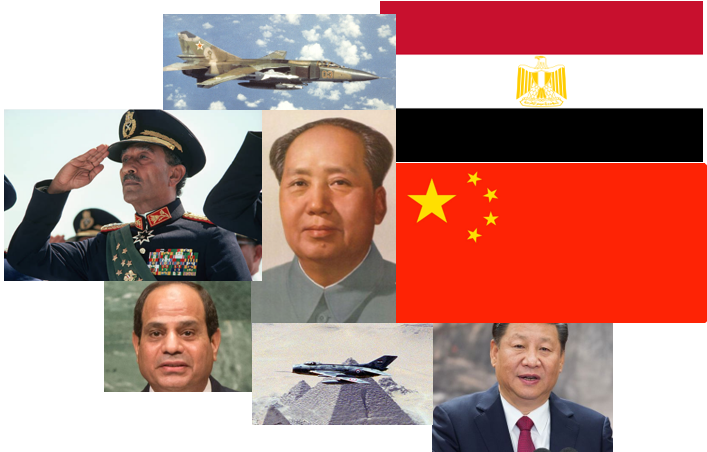
MiG-23 fighter jets began arriving in China in 1978, with Beijing scheming to reverse-engineer the Russian aircraft. Egypt would deliver six Soviet MiG-23s to China over five years, as part of a barter payment for Chinese aircraft.
The reverse-engineering effort to create a Chinese version of the Russian MiG-23 was the Nanchang Q-6 project; it failed and was cancelled due to technical constraints.
Supplying China with the Egyptian Air Force’s Russian-made fighter jets satisfied both Beijing and Cairo’s interests.
In exchange for Egypt providing the Russian MiG-23s, China provided Egypt with Shenyang J-6 (F-6) fighter jets, spare parts, and technical support.
When Egypt’s President Anwar Sadat turned to Beijing for support and provided the MiG-23s to China, Sino-Soviet relations were hostile.
Sadat cut ties with the Soviet Union in the early 70s because Moscow restricted the supply of certain weapon systems to Egypt. U.S.–Soviet detente was a bigger priority for Moscow at the time than Egypt’s military and Sinai reclamation concerns with Israel.
Moscow’s restrictions on deliveries of badly needed defence equipment to Egypt, especially after the 1973 Yom Kippur/October War, had put pressure on Egypt’s armed forces.
By 1974, relations between Cairo and Moscow had soured; Sadat could no longer count on Russian military support and announced that Egypt would end its 18-year dependence on the Soviets as its main defence supplier.
Out of logistical necessity, Sadat would diversify its military suppliers internationally, including China and other countries, and also domestically. In 1975, the Arab Organization for Industrialization (AOI), an Egyptian government military factory, was established.
With the Soviets falling out with Egypt, and as part of the 1979 US-brokered Egypt-Israel Peace Treaty, the US offered Cairo economic assistance and over a billion dollars annually in military aid.
The US remains Egypt’s largest military supplier today through military aid and grants, while China’s defence relationship with Egypt relies on commercial defence sales.
Despite large U.S. military aid, Egypt sources from a variety of countries to supply its armed forces, including France (Rafael fighters), Italy, Germany, Turkey, South Korea, Russia, China, and, at least once, North Korea (Scud missile parts).
In 2018 and 2019, Egypt signed a $2 billion defence agreement with Moscow for several Su-35 fighter jets, but U.S. threats of sanctions saw Egyptian President Abdel Fattah El-Sisi cancel the contract.
Cairo’s motive in going to Moscow was that the U.S. proved unreliable as a supplier when it sanctioned Egypt following the June 30 Revolution/2013 Egyptian coup d’état .
U.S. President Obama withheld certain equipment deliveries to Egypt as a response to removing democratically elected Morsi from power and to the military’s harsh crackdown on Morsi supporters.
Obama blocked deliveries of F-16 fighter jets, M1A1 Abrams Tank Kits (the tanks are assembled locally), Apache Helicopters, and Harpoon Missiles.
Because the U.S. proved unreliable, in 2013, Sisi turned to various other suppliers, both in the West and in Russia, while putting the PRC into sharper focus.
Egypt and the PLA Navy held their first joint exercises on August 21, 2019, off the coast of Alexandria; this sent a message to Washington.
In a region divided by varying interests and conflicts, Beijing sees opportunity in Egypt, not only in military cooperation but also in advancing geostrategic and economic interests to counterbalance U.S. influence in Cairo.
Egypt is in a key geographic location in North Africa and Asia, home to the Suez Canal. It borders the Red Sea and the Mediterranean and is a strategic point for the Middle East and Africa.
Egypt is the top military power in the Middle East and Africa. ‘On paper and in global assessments like the Global Firepower Index, Egypt ranks first among Arab nations and inside the global top 20. ’
But Egypt’s military power is limited by its economic struggles.
Nonetheless, Egypt’s diversified military sourcing policies would keep China in check because, as the U.S. knows, and despite U.S. influence, Cairo maintains military cooperation options with several other countries should any one military partner falter.
China might believe it can manoeuvre itself into Egypt to strongly influence Cairo and push U.S. influence into a corner, but this could be a difficult task.
Cairo is savvy to Beijing’s record of soft power tactics and influence; Egypt has learned past hard lessons; ergo China will find that Egypt’s government trusts no one and takes autonomy seriously.
Meanwhile, Washington remains a hurdle for China as the U.S. is Egypt’s biggest arms supplier and economic aid provider.
Sisi’s government is constantly weighing its economic and military interests while taking an extremely cautious approach to avoid reliance on a single source or partner. Yet, U.S. power and influence on Cairo remain undeniably strong.
Regardless of U.S. economic influence, Egypt is aligning with China on common economic interests; both countries are members of BRICS, a group of emerging economies and developing countries that seeks to challenge Western-dominated sectors.
Given regional events, Cairo is content to build closer military and economic ties with China, as evidenced by the two countries’ first joint air force exercise, “Eagles of Civilization 2025,” held last year in Egypt from April 19 to May 4, 2025.
(There is speculation that, as a result of ‘Eagles of Civilization’, Egypt’s Ministry of Defence has purchased several Chengdu J-10C “Vigorous Dragon” multirole combat aircraft.)
The PRC excels in military production and could provide Egypt with some economic stimulus, but its reliability as a strategic partner is questionable. For example, during the U.S.-Iran war, Beijing supports Tehran while simultaneously assuring Egypt and other Arab states targeted by Iran that it could use its influence in Iran to help de-escalate the conflict.
Despite Cairo’s desire to project sovereignty and regional leadership, Washington could again exert pressure on Egypt if it believes Cairo is going too far in expanding its military ties with the PRC, as it did when it threatened sanctions, forcing Sisi to cancel the Russian Su-35 contract.
Overall, Egypt is maneuvering among competing powers, treating military diversification as necessary while leveraging China’s interests to advance its own.
–RdM
https://rdmsecurityanddefence.com
✱Coincidentally, there is this announcement from President Sisi’s Office:
President El-Sisi Receives China’s President Xi Jinping During his Official Visit to Egypt
Wednesday, 26 August 2026 / 10:25 AM
Within the framework of the outstanding bilateral relations between the Arab Republic of Egypt and the People’s Republic of China, Spokesman for the Presidency Ambassador Mohamed El-Shennawy stated that Chinese President Xi Jinping will pay an official visit to Egypt in the coming days.
Addendum (22 Sep 2026):
🔴 See: The Sino-Egyptian Cautious Partnership: https://lnkd.in/p/gaJ8a2PY
and see: https://roycedemelo.com/2026/09/15/the-sino-egyptian-cautious-partnership/
Middle East, African, and Mediterranean interests have led China to deepen its diplomatic influence and economic and military cooperation with strategically located Egypt, even as it clashes with Cairo’s longstanding strong ties to Washington. All the while, Cairo maintains strategic autonomy.
In early July last year, Sino-Egyptian relations leaped forward after Chinese Premier Li Qiang visited Cairo, fresh from the BRICS summit in Rio de Janeiro, Brazil. He met with Egyptian President Abdel Fattah El-Sisi and Prime Minister Mostafa Madbouly.
On September 1 to 2, 2026, Chinese President Xi Jinping visited Cairo for the first time in ten years to celebrate 70 years of diplomatic relations with Egypt.
Beijing’s long-time diplomatic efforts to expand and secure bilateral cooperation in trade, infrastructure, agriculture, and technology appear to have gained ground during Li Qiang’s visit.
Nonetheless, Cairo proceeds with caution.
What could go wrong with a Muslim and Chinese alliance??? 🤔
There is the Iran-China relationship and see how that is turning out. re: ‘War, Sanctions and The China-Iran Partnership,’ July 28, 2026: https://roycedemelo.com/2026/07/28/war-sanctions-and-the-china-iran-partnership/